
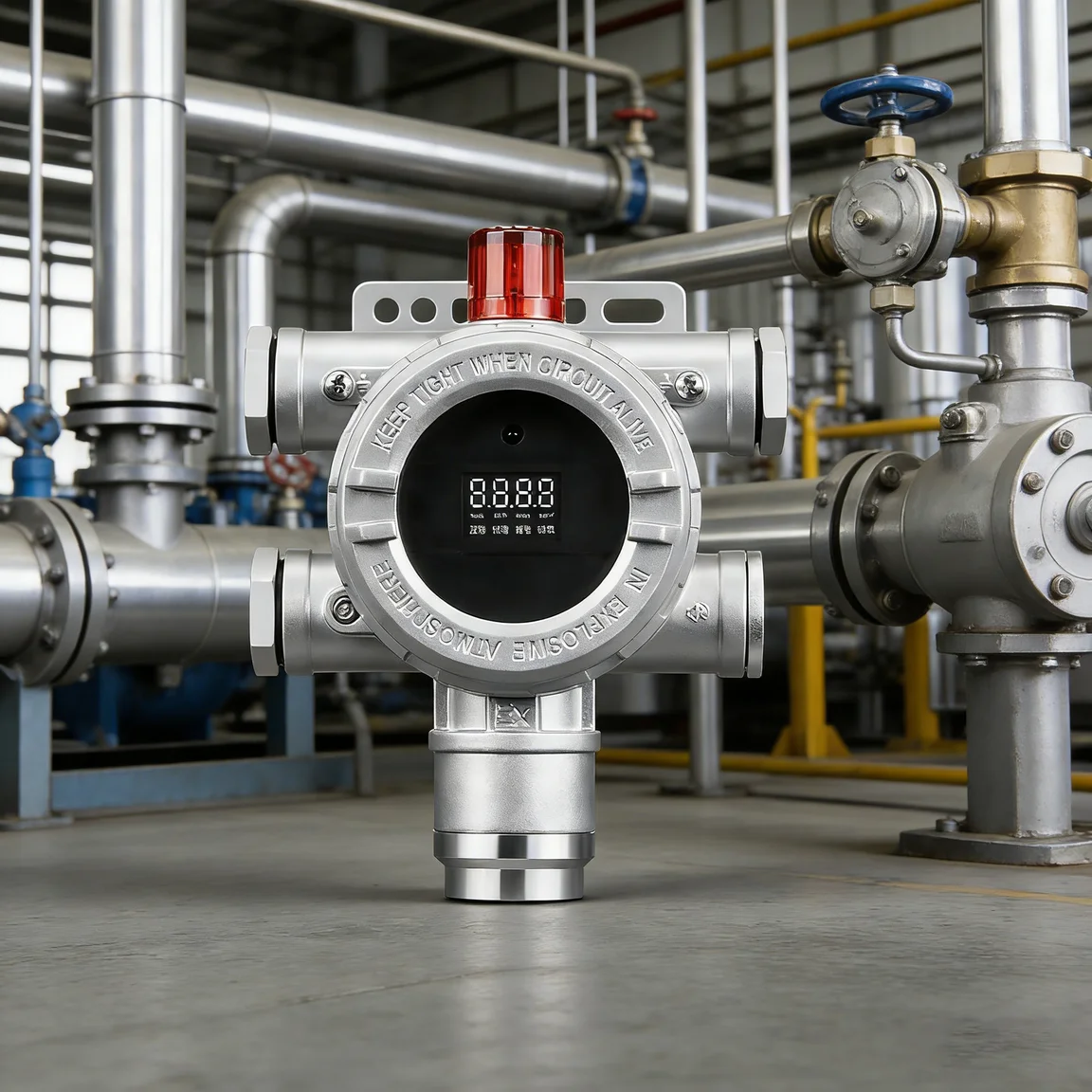
Many industrial facilities still rely on legacy gas detection systems that, while functional, lack the intelligence, connectivity, and diagnostic capabilities required for modern safety standards. These older systems often use outdated sensor technologies, require frequent manual calibration, and offer limited data visibility. However, replacing an entire detection infrastructure is costly, disruptive, and often unnecessary. Retrofitting legacy gas detectors with smart components enables facilities to upgrade performance, enhance reliability, and integrate with modern monitoring platforms—without a full system overhaul.
Why Retrofit Instead of Replace?
Complete replacement of gas detection networks involves significant capital expenditure, extended downtime, and complex re-engineering of wiring, control panels, and safety protocols. In contrast, retrofitting preserves existing infrastructure—such as cabling, enclosures, and mounting hardware—while upgrading only the core sensing and communication modules. This approach reduces costs by up to 60% compared to full replacement and minimizes operational disruption.
Key Components Suitable for Retrofit
The most effective retrofit strategy focuses on replacing or enhancing three primary elements: the gas sensor module, the signal processing unit, and the communication interface. Modern smart sensors, such as those used in the GDE series from Shanghai Gowe Electronic Safety Equipment Co., Ltd., support plug-and-play integration with legacy 4–20mA loops and RS485 buses. These sensors feature pre-calibrated smart cartridges that can be swapped in minutes without tools or recalibration.
Selecting the Right Sensor Technology
Choosing the appropriate sensing principle is critical for accurate and reliable detection. The core of any gas detector is its sensor, which converts gas concentration into an electrical signal. Common types include:
- Catalytic combustion: Ideal for detecting combustible gases like methane and propane. Offers high sensitivity but may degrade in silicate or sulfide environments.
- Infrared (IR) sensors: Immune to poisoning, suitable for long-term use in harsh conditions. Used in GDE and GDC series detectors for stable performance over >5 years.
- Electrochemical sensors: Best for toxic gases such as CO, H₂S, and NO₂. Provide linear output and low power consumption.
- Semiconductor sensors: Cost-effective for broad-range detection but less precise in fluctuating humidity.
- Photoionization (PID): Detects volatile organic compounds (VOCs) at very low concentrations.
For retrofit applications, infrared and laser-based sensors are increasingly preferred due to their longevity, minimal drift, and resistance to environmental interference. The GDE series, for example, employs high-performance IR/laser sensors with automatic temperature compensation and zero-point calibration, ensuring consistent accuracy even after years of operation.
Integration with Smart Systems and Cloud Platforms
Legacy systems typically operate in isolation, with alarms triggered locally and no centralized data logging. Retrofitting enables integration with IoT-enabled controllers and cloud-based monitoring platforms. The GM810/GM820 gas alarm controllers support modular expansion, auto-addressing bus communication, and real-time data transmission via 4G or Wi-Fi modules. These controllers can interface with existing detectors while adding remote diagnostics, event logging, and mobile alerts through dedicated client apps.
Benefits of Cloud Connectivity
With cloud integration, facility managers gain access to historical trend analysis, predictive maintenance alerts, and compliance reporting. The GDC series detectors, when paired with the GM8 platform, transmit status updates—including sensor health, calibration history, and fault codes—directly to a centralized dashboard. This eliminates manual inspections and reduces false alarms through intelligent diagnostics.
Maintaining Safety and Compliance During Retrofit
Safety must remain paramount during any upgrade. All retrofit components should retain or exceed original certification standards. Products like the GDA and GDC series are certified to GB15322, GB3836, and carry CCC, CPA, and explosion-proof ratings (Exd IIC T6Gb), ensuring compliance in Zone 1 and Zone 2 hazardous areas. Their robust housings—available in aluminum or stainless steel—withstand corrosive environments and extreme temperatures from -40°C to 70°C.
Additionally, features such as tool-free maintenance, pre-calibrated sensor cartridges, and remote configuration reduce technician exposure to hazardous zones. The inclusion of relay outputs allows seamless triggering of external devices like ventilation systems or shutdown valves, maintaining fail-safe operation.
By strategically retrofitting legacy gas detectors with modern smart sensors and controllers, industrial operators can achieve near-state-of-the-art performance at a fraction of the cost. Solutions from Shanghai Gowe Electronic Safety Equipment Co., Ltd.—including the GDE, GDC, and GDA series—demonstrate how intelligent design, modular architecture, and cloud connectivity can transform aging safety systems into proactive, data-driven networks—without tearing out existing infrastructure.