
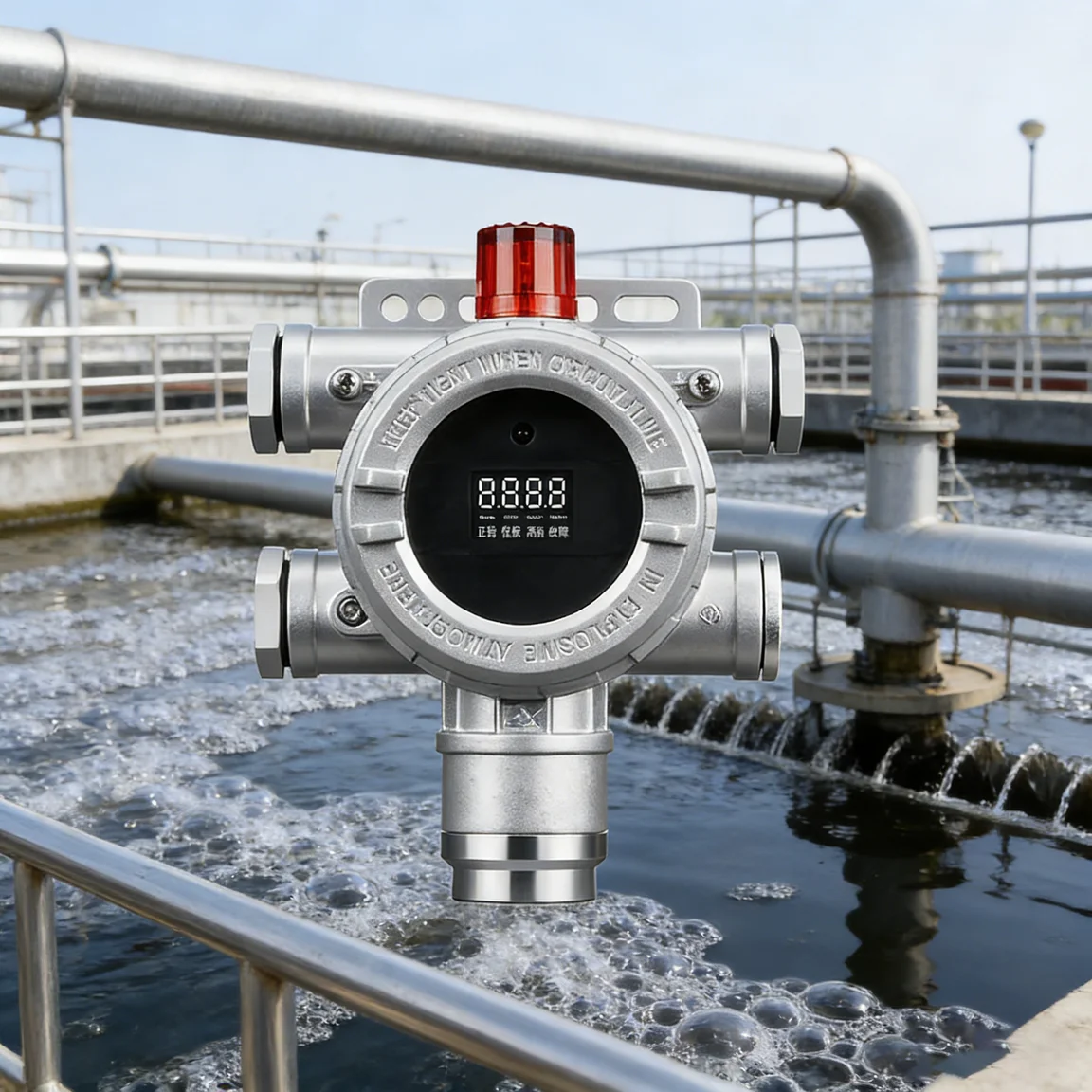
System Architecture for Reliable Industrial Monitoring
Wireless gas detector networks require a robust architecture to ensure continuous monitoring across large industrial facilities. The core components include **gas detectors**, communication gateways, and centralized control platforms. Each node in the network must support multiple signal outputs such as 4-20mA, RS485, and digital relays to interface with existing infrastructure. For instance, the GDE series from Shanghai Gewe Electronic Safety Equipment Co., Ltd. integrates infrared/laser sensors with dual output modes—bus and分线—enabling flexible deployment in complex environments like petrochemical plants or power stations.
These detectors utilize intelligent sensor technology and automatic temperature compensation to maintain accuracy under fluctuating environmental conditions. With a typical response time (T90) of 20–25 seconds and measurement precision of ±3% for infrared models, they meet stringent industrial safety standards. Additionally, their modular design allows integration of different sensor types—catalytic, electrochemical, PID, or semiconductor—based on target gases.
Sensor Selection Based on Application Requirements
Choosing the correct detection principle is critical for system reliability. Catalytic combustion sensors5 years), immunity to poisoning, and stable performance in oxygen-deficient areas, making them ideal for continuous monitoring in confined spaces. Electrochemical sensors excel in detecting toxic gases like CO or H₂S with high specificity, while PID sensors provide rapid response to volatile organic compounds (VOCs).
Shanghai Gewe’s GDC series supports interchangeable pre-calibrated smart sensors, allowing field technicians to swap sensing elements without recalibration. This feature reduces downtime and maintenance costs. The detectors also include built-in diagnostics that report sensor faults via current output deviations—for example, a 2–2.5mA signal indicates a faulty sensor, enabling proactive maintenance.
Communication Protocols and Network Integration
Modern wireless networks leverage both wired and wireless backhaul options. While 4-20mA loops remain standard for analog signal transmission over distances up to 1.5km, RS485 enables multi-device daisy-chaining on a single bus. For remote or hard-to-wire locations, integrated 4G and Wi-Fi modules facilitate real-time data upload to cloud platforms. Gewe’s IoT-enabled detectors support these protocols natively, ensuring compatibility with SCADA and DCS systems.
The GM810/GM820 gas alarm controllers act as central hubs, aggregating data from up to hundreds of detectors. They feature auto-addressing bus communication, eliminating manual node configuration. With touch-button operation and modular expansion slots, these controllers adapt to evolving facility layouts. Alarm thresholds are programmable, and relay outputs can trigger external devices such as ventilation fans or shutdown systems.
Environmental Durability and Compliance
Industrial environments demand equipment rated for harsh conditions. All Gewe detectors comply with GB15322 and GB3836 standards, holding CCC, CPA, and explosion-proof certifications. Housings are constructed from corrosion-resistant materials—powder-coated aluminum or optional stainless steel—with IP66-rated enclosures. Operating temperatures range from -40°C to 70°C, and humidity tolerance reaches 95% RH without condensation.
For Zone 1 and Zone 2 hazardous areas, the detectors employ flameproof (Ex d) or intrinsically safe (Ex ia) designs. The GDA series, optimized for compact installations, includes dust-explosion protection and white LED concentration displays visible from 25 meters away. Remote configuration via infrared eliminates the need to open enclosures, reducing exposure risks during maintenance.
Cloud Connectivity and Predictive Maintenance
Integration with Gewe’s proprietary cloud platform enables real-time monitoring via mobile apps and web dashboards. Historical data logging supports trend analysis, helping identify gradual sensor drift or recurring leak patterns. Automated alerts notify personnel of anomalies before they escalate. The system also tracks calibration schedules and sensor lifespan, streamlining compliance reporting.
With support for advanced gas detection technologies, including multi-spectrum flame sensing and AI-driven diagnostics, Gewe delivers end-to-end safety solutions. From standalone detectors to full-scale networked systems, their product portfolio ensures seamless coverage across diverse industrial applications.